


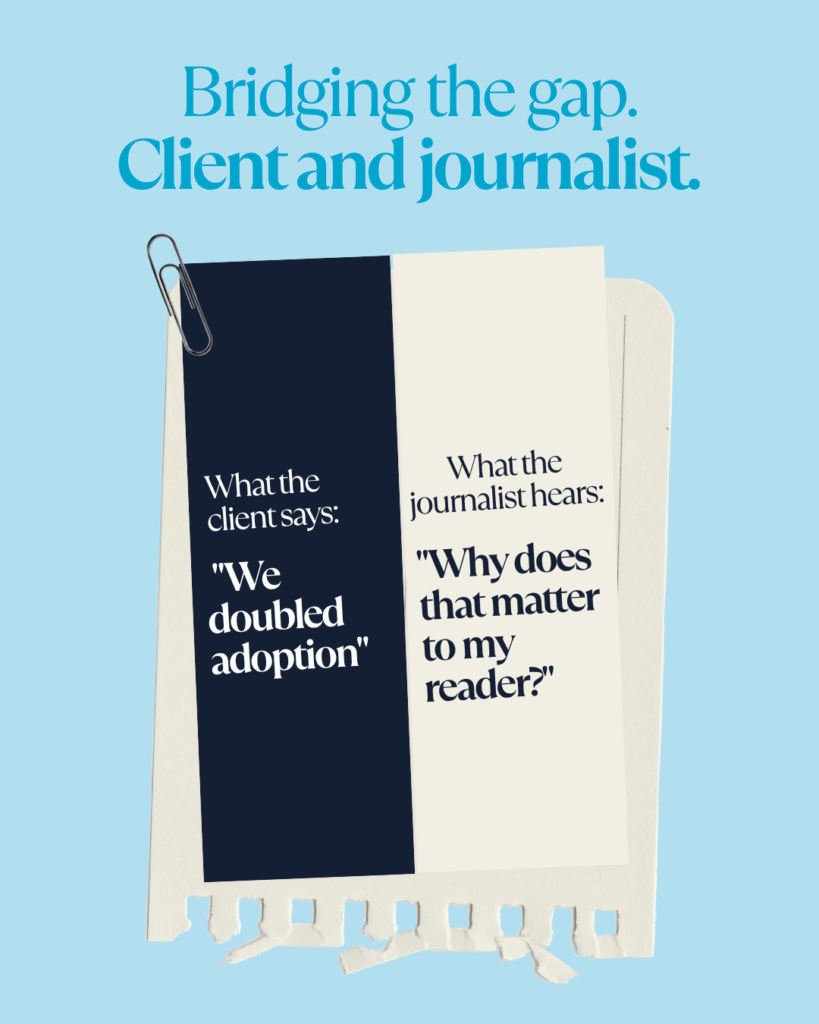
Anyone who has spent enough time in PR starts to notice why many pitches fail to land. Often, the issue is not that the announcement lacks value, or that the journalist is being difficult. More often, the story has been framed from only one side.
The client is focused on what they need to communicate. The journalist is asking whether the audience has a reason to care.
Most of the work in PR happens in that space between business priorities and editorial judgment. The gap may never close completely, but it can be managed with sharper thinking, better context, and a more honest understanding of what both sides need.
What reporters want
Most of the time journalists are reasonable when you put something worth their time in front of them. They’re not difficult people. They have a very specific job, which is to find content that connects with their readers. A new office opening for example, rarely delivers on that objective. A milestone announcement doesn’t either. A senior hire can, if it signals something larger about where a sector is moving, but on its own it’s information rather than news.
The question editors ask, sometimes silently and sometimes out loud, is a version of this: so what? Why is this a story, why today, why would a reader spend three minutes of their time reading this rather than something else. If a pitch doesn’t carry an answer to that question in the first sentence, very little else about it matters.
The conditions journalists are working under now make this less forgiving than it used to be. A reporter who once had a morning to chase a story has an hour, sometimes less, and is also expected to file a social post, cut a video, sit in on an editorial meeting. Pitches that need patient unpacking don’t get unpacked.
On the client’s side
Clients are not wrong to want some grip on how their story is told. They’ve spent years building a reputation that a single bad article can dent, with boards watching and investors reading and competitors paying close attention to every public statement. None of that is paranoia. It’s the job.
The trouble starts when that reasonable instinct slides into expecting media to behave like a paid channel. Guaranteed placement, headlines that mirror the messaging deck, quotes used verbatim with no editorial interference. Journalists who sense they’re being used as distribution don’t engage, and they remember which agencies were the ones reaching.
There is a related issue. Companies that bring a marketing mindset to a press release tend to produce something that reads exactly like that, and the two disciplines, while not in opposition, are not the same thing. Marketing seeks to persuade. Journalism seeks to explain. Readers, in my experience, can feel the difference from the first paragraph.
Where the story actually sits
The simplest fix is to stop leading with the announcement itself.
Clients often resist this because it feels like the news is being pushed aside. It is not. Leading with the problem the announcement solves, or the market shift it reflects, gives the journalist a story they can actually tell. The announcement then becomes the proof behind that story, rather than the story itself.
Data works the same way. A company saying it doubled customer adoption last quarter is simply a claim about itself. Tie that figure to a trend the journalist is already following, and it becomes evidence they can build a story around.
Honesty – client facing and media facing
The PR role, when it works, looks something like translation, but the translation has to be honest in both rooms.
With clients, that means saying clearly and early that editorial decisions sit with editors, that coverage isn’t a contractual output, and that some stories which feel obvious from inside an organisation need significant work before they hold up outside it. This isn’t pessimism. It isn’t lowering expectations. It’s the kind of conversation that lets a client relationship survive the months when results don’t go to plan, which they sometimes won’t.
With journalists, it means not wasting their time. Not pitching what isn’t ready yet. Not following up three times on a story that was never going to run. I still see agencies sending the same pitch angle to four people on the same desk, which is the fastest way I know to lose access to a publication and every ounce of respect. People talk. Credibility, once it’s gone in a particular newsroom, takes years to come back, if it comes back at all.
A few things that move the needle
These are observations more than principles.
Stories travel further when they connect to something already in motion. A regulator doing something. A procurement cycle reshaping. A debate that’s been running in the trade press for weeks. A pitch that slots into context a journalist already cares about gets a different kind of attention than one that arrives standalone.
Numbers help, but only the right ones. The claim that a company is a market leader is empty. A figure that shows scale, or trend, or material risk, one a reporter can quote and verify, is useful. Useful things tend to get used.
Timing matters more than it gets credit for. The same story released into a crowded news week and released alongside a relevant conference or policy moment can perform very differently. This is knowable in advance, and worth planning around.
Exclusivity changes the nature of the conversation entirely. Giving a journalist something no one else has, whether that’s data, a spokesperson willing to speak directly about something uncomfortable, or early access to a finding, shifts the relationship from pitching to collaboration. Collaboration happens with people who have earned it.
What success actually looks like
Clip counts are easy to compile and not especially useful as a measure of whether the work delivered was a success.
One piece in the publication that ten of the right people read closely is worth more than a dozen mentions in outlets where the relevant audience doesn’t exist. The solid questions, the ones I don’t think we ask often enough, are whether the coverage reached the people it needed to reach, whether the substance of the story came through alongside the brand name, and whether anything actually moved as a result. A perception. A conversation in a board meeting. A journalist who now knows who to call.
They take longer to gain momentum but once they do, the results speak for themselves. And in the end, those outcomes are what the work is there to deliver.